Total Pageviews
Saturday, March 5, 2011
Llama Show Dropouts
Thursday, February 17, 2011
Of Mice and Popcorn?
That day in the field, it was Bahama Llama sending a buttered popcorn scent our way. Dalai Llama, however, let out a burned popcorn smell. That was unpleasant, but at least it didn't smell like mice!
Llamas release their scent from oval-shaped, leathery glands located on their lower back legs (metatarsals). Here’s what that patch looks like, courtesy of the very handsome Dalai Llama:
| Dalai Llama's Metatarsal Scent Glands |
On numerous Llama Walks, people have noticed Dalai Llama's lovely scent glands and have asked if he had a boo-boo. Nope! Scent glands are just highly visible on light-colored llamas. Every llama has scent glands, but most of these narrow patches are covered by wool. Dalai Llama is a Peruvian llama, which are known to have relatively little wool below the knees.
Friday, February 11, 2011
Llama Cookies
| Enough Llama Cookies for a Pack! |
1 cup flour
1 cup shredded carrots
1 tsp. salt
1 tbsp. sugar
2 tbsp. vegetable oil
1/4 cup water
1/4 cup molasses
Saturday, February 5, 2011
Should You Own a Llama?
| Best Friends: The Dalai Llama & Barack O'Llama |
![]() | |
| Four of the llamas in ShangriLlama's medium pack. |
![]() |
| ShangriLlama's Playpen |
Llamas must live on land that is zoned for horses or livestock, even if the land is big enough for a small or large pack of llamas.
Very few veterinarians are trained to come to the aid of a sick llama. Llamas are remarkably hardy animals, but you may be hard-pressed to find qualified emergency medical care. Why? Llamas have not been studied long in the U.S., and most veterinary schools don't teach about them.
There are more than 125 common plants that are poisonous to llamas. Clear identification and cross referencing of every single plant and weed must be made before bringing llamas onto your property. That's why llamas live on dirt-lot properties or within fenced grassy fields, usually far enough away from neighbors that leaves don't blow into the llamas' field. In the spring, diligence is required to remove plants that grow seemingly overnight after birds, rabbits, squirrels and other critters move from yard to yard.
Friday, January 28, 2011
Llama-tude
| Extroversion | Introversion |
| Sensing | Intuition |
| Thinking | Feeling |
| Judgment | Perception |
Let’s take a look at the pack's personality test results. Which llama do you think and act like? That's your llama-tude!
| Pajama Llama is the most serious in the pack. |
Como T. Llama
Como T. Llama couldn’t be more different than Pajama Llama; in fact, his temperament is the exact opposite! This could explain why the two never hang out. Como is a totally action-oriented extrovert. He wants to play, play and play! But he can’t help it; he’s an ENFP. He acts first and thinks later—or not until Pajama Llama sets him straight with ears back and a stern look. And while Pajama Llama will carefully evaluate a situation, Como relies on his feelings and simply blurts out an alarm call when there really isn't any need to round up the other boys. He's a spontaneous llama who just wants to have fun. Are you a Como T. Llama?
| Bahama Llama is everyone's favorite llama. |
Dalai Llama
Dalai Llama is an ISFP, meaning that he is Introverted, Sensing, Feeling and Perceiving. His introversion dominates his personality. It makes him gentle, sensitive, patient and tolerant. That’s why he prefers to linger at the back of the pack instead of asserting himself. However, because of his beautiful, mystical blue eyes and silky white coat, he appears to be cool and aloof. But he’s really not; he’s quite friendly! In fact, the other llamas invite him to wrestle in almost every match in the arena. Dalai is good at wrestling the other young llamas to the ground, yet he doesn't desire to move up in his pack ranking. He is just happy to be invited to play. Are you a Dalai Llama?
| The opinionated Barack O'Llama |
Barack O’Llama is affectionately called “Barry.” He’s an ESFJ, which makes him the perfect companion for Dalai Llama. And the two really are best buddies! Barry’s extroversion balances Dalai’s introversion, while their common sensing ability makes them both evaluate situations similarly. But Barry is still quite different from Dalai. He often overreacts when his feelings are hurt by another llama encroaching on his personal space. That’s when spit happens, and Barry is the spittiest of the ShangriLlama llamas. But don’t worry; none of them spit at people. Heaven forbid! Only abused or poorly trained llamas do that, and ShangriLlama’s llamas are well trained and quite pampered. Mama Llama thinks that Barry’s spitting may be his way of sharing his opinion about—everything—which is a typical characteristic of an ESFJ, along with talking a lot. Barry, of course, hums rather than talks. Do you happen to be a Barack O’Llama?
Wednesday, January 19, 2011
Llama Beans & Tea
![]() |
| Pajama Llama cooks up some llama beans. |
![]() |
| Genuine Llama Beans for your garden |
Dirty Llama
Llamas grow wool coats that are lightweight, medium-weight or heavyweight, and ShangriLlama's pack represents all three coat types. Together, the llamas of ShangriLlama also represent most of the wool colors found in this species.
![]() | ||
| There's a llama under all that hay! |
Dalai Llama grows a lightweight wool coat, which is white and shows dirt very quickly. A month ago, Mama Llama hired a llama groomer to bathe Dalai. It took two hours and the results lasted barely a day before Dalai looked a bit yellowed (if you know what I mean) in certain spots on his coat. Look at poor Dalai Llama in the middle of his soapy bath!
![]() |
| Dalai Llama Endures a Bath |
| Como T. Llama has a medium-weight wool coat. |
Pajama Llama and Bahama Llama have lightweight coats like the Dalai Llama. Simply brushing them with your hand will make their coats look spotless. Don't let Bahama's woolly mane fool you. He really does have lightweight wool on the parts of his coat that are used for garments and accessories. His luscious mane serves only to help him masquerade as Santa Claus every December.
Llamas actually have two coats: the outer coat that catches a lot, a little or no debris, depending on the wool type; and the inner coat, which serves to keep the llama warm. The outer wool is great for rugs, blankets and llama leads (like leashes, only longer). The inner wool is much finer and more valuable, so it is used to make luxurious garments and accessories. In southern California, llamas are shorn each May to keep them cool for the summer, which still gives them time to grow back their wool when colder weather sets in.
Llamas that aren't curly are called silky (huacaya, in Peruvian). And whether curly or silky, llama wool has almost no lanolin (oil) in it, so it hypoallergenic! Because the wool lacks oil, it should only be washed twice a year, unless it is necessary to wash it more, as in Barack O'Llama's case. And then, spot cleaning is best.
Monday, January 17, 2011
Upside Down Llama
![]() |
| Pajama Llama Enjoys a Good Backscratch |
Llama backscratching is both predictable and methodical. It's easy to guess when a llama is going to drop and roll. First, the llama puts his head on the ground with his rear elevated. Then he scratches at the ground just like a cat does in a cat box. Next, he drops to the ground and rolls onto his left side, then upside down, and finally onto his right side. If the dust has some coarse bits in it, then the llama may repeat his crazy upside-down dance moves. Then he shakes off the dust and finally stands up--as if nothing has happened. It's really quite a sight!
Aside from a dust bath, llamas also roll in dry, crumbly dirt, sand, and food-grade (not pool-grade) diatomaceous earth, known as edible DE. But they won't roll in mud, and Mama Llama is grateful for that.
Llamas roll for a variety of reasons: to scratch their backs, to suffocate bugs that may have landed on their fiber, to keep their coats healthy and dry, to mark their scent, and to use the dust as sunscreen. Smart! Many other animals roll in dust or crumbly dirt or sand, including birds, cats, dogs, hamsters, chinchilla, pigs, horses, bison and elephants. These animals experience contentment, too, when they roll. In the photo above, it does look like Pajama Llama is having fun.
Sunday, January 16, 2011
Llama Check-Ups
![]() |
| Barack O'Llama found out that he'll have his annual physical today. |
![]() |
| Mama Llama can't watch as her llamas have their annual physical exams. |
Truly, the exams don't hurt the llamas, but these animals don't like human touch, so they don't understand why anyone would touch all over their bodies. It turns out that there was lots of llama drama going on, because moments after each llama finished his physical, he was off playing again, as if nothing had happened. Mama Llama, however, is still recovering from her boys thinking anyone was trying to hurt them--which they weren't.
1. Flies carry worms, and flies love to swarm around and land on stinky poop. But llama poop is virtually odorless! Mama Llama is not making this up! It must be a real disappointment to flies that pass through a llama stable to find that there's nothing smelly enough or wet enough to interest them. So flies go bother the horses--as long as the llama ranch has been diligent in picking up the llama beans, which we are.
2. Flies really enjoy buzzing around the faces of horses and other large animals. Not only are the flies annoying these animals, they are also landing on their face and depositing eggs there. When these animals lick their face, they ingest the eggs. Good protein? Yes. Bad for the animals? Definitely. But here's the good news, at least for llamas: They can't lick their faces, because their tongues can only extend one inch outside their mouths! So again, no need to routinely immunize llamas because of buzzing flies. Lucky llamas!
Llamas are de-wormed only for cause. Do whitetail deer pass through the llamas' field? If so, monthly dewormers are needed. Do the llamas share ground with other barnyard critters? Then testing for parasites is needed, and if the parasite load warrants it, then dewormers must be used. Is the llama field often damp, or is there a stream they drink from? Those are additional reasons for parasite testing and potential deworming. But because parasites have grown resistant to many dewormers, it is not recommended to deworm unless there's proof of parasites in the llamas' gut.
Saturday, January 15, 2011
Llama Llunch Pack
Guess what you would discover inside the llama pack below? Lunch for five people! That's right. Bahama Llama is pictured here carrying everyone's lunch on our animal adventure to the park. He also has a half case of water in his pack. Bahama Llama is perfectly content serving as the pack llama, because that's what llamas are primarily used for.
![]() |
| Bahama Llama Carries Lunch for Five People |
Do you know why Bahama Llama was chosen as the pack llama? It's because he's...well...pleasantly plump. By carrying the pack, he has to spend a few more calories to get around, and that's good. If a llama gets too chubby, its ankles (pasterns) start to get spongy. After a while, the llama will not walk correctly and then can't walk very far. Wish Bahama Llama luck getting the weight off, because he has a huge appetite, despite many efforts to satisfy him with lower-calorie feed. But he sure is handsome and has the best temperament that Mama Llama has ever encountered. So he really is pleasantly plump.
But Pajama Llama is overweight, too, so he'll be trading off with Bahama Llama to carry the pack on upcoming Llama Walks. Mama Llama thinks she overheard these two chubby llamas talking about joining Jenny Craig as their New Year's resolution. Now that would be an interesting ad campaign!
Happy Trails from Mama Llama!
Llama Cousins
![]() |
| Llamas |
![]() |
| Guanaco, the llama's wild cousin |
![]() |
| Alpacas |
![]() |
| Vicuna, the alpaca's wild cousin |
![]() |
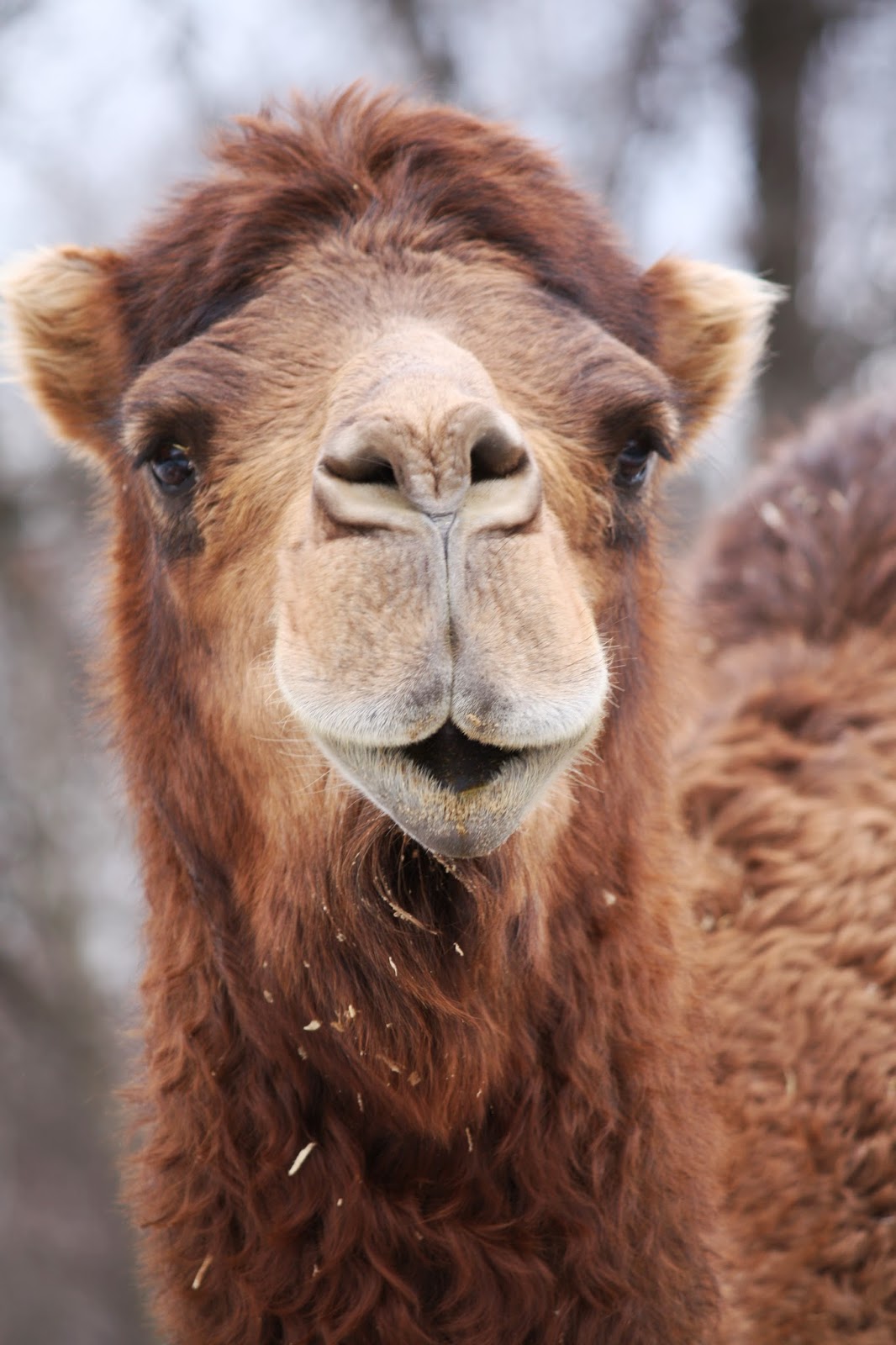
| Yup, it's a camel--distant cousin of the llama and alpaca |
Why does Mama Llama favor the llama over its camelid cousins? Well, it's pretty obvious when it comes to the camel. Scary! Don't mess with a camel! Then we have the wild cousins--guanaco (gwan'-ah-co) and vicuna (vah-coon'-yah), which, like the domesticated alpaca, are "sheepish," meaning that you can't easily hug or pet them or pal around with them.
But llamas? They're highly social animals. They like to be stroked on their long necks, and they're the only camelids you would enjoy taking a walk with. That's one of the many reasons that we established our private zoo for llamas--so you can spend some time getting to know this very friendly animal. We stock males only, because within the camelid family, male llamas are the friendliness. There's a method to our madness here at ShangriLlama!
And isn't it interesting how many colors the llama comes in? At ShangriLlama, we purposely chose different colors for our pack, among the many options which include black, white, brown, tan and gray in solid, patchwork, and spotted (appaloosa) patterns! The llama's cousins are pretty much just shades of brown--lovely browns--but brown.
It is true that the vicuna, guanaco and alpaca have more luxurious wool than a llama. But what fun is that if you can't easily pet these animals and can't afford to buy its wool at $1,800 to $3,000 per yard?!
The only thing a camel has that might be fun to have on a llama is its hump. People ask Mama Llama ALL THE TIME if they can ride llamas. Nope; no self-respecting llama will let you, because that would hurt their backs! However, lllamas will gladly carry your lunch or your camping equipment in a proper pack on their sides. Walking next to them is plenty fulfilling, just to have the pleasure of the gentle llama's company.
If you've never walked with a pack of llamas, then you're missing out on an unforgettable experience with the most gentle of the four camelid cousins. Do add this to your life's "bucket list!"
Happy Trails from Mama Llama!
Thursday, January 13, 2011
Kushy
Llamas Go "Green" After Christmas
The llamas of ShangriLlama are so lucky that they live on a Christmas tree farm. They rarely pass up the opportunity to take a nibble from a cut-down tree. They mow lawns for free, too, by happily grazing off tall blades of grass, plus weeds and other dried vegetation that are within their limited diet.
Look how well the llamas polished off this Christmas tree...
Now Mama Llama can never again look at a "used" Christmas tree without thinking that it could have been a treat for a pack of llamas. Not all trees qualify: they aren't suitable for llamas if they have been sprayed with pesticides, herbicides or frosted white, pink or any other color, either. And only Douglas Fir trees are safe for llamas. The other Christmas tree varieties are on the Bad List of plants never to feed a llama.
Happy Trails from Mama Llama!
Tuesday, January 11, 2011
Happy Birthday, Bahama Llama!
WARNING! This song has a million verses and gets stuck in your head!
Monday, January 10, 2011
Eat NO Fruits or Vegetables?
Sunday, January 9, 2011
Llama Alarm Cry!
Click to hear the Llama Alarm Cry: https://www.youtube.com/watch?v=p_JIUS9PPxw&t=5s
- Did you find that sound eerie?
- Did you disbelieve that the white llama was emitting that sound?
- Do you think it sounds like chickens under water, or a crying baby?
- Did you notice that the llama never opened his mouth?
Saturday, January 8, 2011
Llama Pedicures
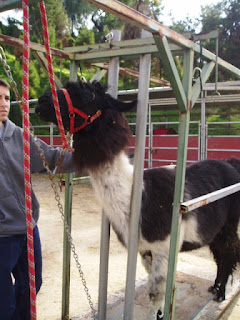
Here are the bottoms of a llama's feet. Pretty, cool, huh! See the black pads? They're leathery and kinda squishy. The llama's toe nail surrounds the pad, like a frame. The nail is very black and should not extend much beyond the tip of the pad. The extra can be cut off with what look like sharp garden shears, and it comes off easily--if you know what you're doing.
During the pedicure, the groomer was chatting about his 22 llamas and what they like to snack on. He said they love bananas with and without their peel, plus rose petals, mini corn cobs, apple slices, salad (without dressing), and sliced, unpeeled oranges. Really? We're going to offer some of these treats to the llamas tomorrow!